Monday, March 11, 2013

The Making of a Mattress

We recently realized that it was time to replace our mattress.  We quickly learned that the process of buying a new one can be quite daunting.  Traditional mattress salesrooms are staffed by pretty aggressive salespeople who all have different theories of what's best for you.  After a few confusing visits, we followed the lead of our good friends Steve and Gina Harris, and checked out the McRoskey showroom on Market Street.


It was a much less overwhelming experience, as they only had a few basic options, and we soon realized that this was the new bed for us.  When I learned that they are actually made right in San Francisco, I asked if it might be possible to visit the factory and watch our mattress production in progress, and they said I'd be more than welcome to come do so.


I showed up and met first with the factory manager, who's name, if I remember correctly, is Paul, and then we were joined by third generation owner Robin Azevedo.  I was amazed that they spent over an hour with me, showing each step of the process.  


The first station we visited was the sewing room, where a couple of women were hard at work cutting and edging the fabric that would eventually wrap the mattress.  They also popped in eyelets for ventilation, and handles for flipping.  


Next we proceeded downstairs to an area where heavy gage steel wire was formed into individual coils, and thinner wire was spun into small coils to bind the edges of the larger ones.  The coils were then crimped together and attached to wooden frames for the box springs, or combined into large rectangles for the mattresses.


The coolest equipment was in the room where they refined the wool and cotton filler for the mattresses. Huge bales of both materials come in, and get sent through a series of machines that refine it, and weave it into very thin sheets, that are then layered to create the fill.  These machines were quite beautiful, and the change in the material was pretty amazing.


Finally, i went into the assembly area where all the parts come together to form the mattress.  The workers were covering both sides of the spring box with layer upon layer of cotton or wool, and then wrapping that in the fabric.  The guy who ran the seaming machine has worked there for years (as have most of the people I met), and is incredibly skilled at what he does.  After it's all assembled, it's still about twice the thickness of the final product, so it goes into what seems like a giant stapler, that creates the stitched dimples that compress it and hold it all together.


All in all, it was a fascinating tour, and I know that they welcome other visitors who either call or sign up on their website, and we are sleeping quite comfortably on the new mattress now!

Sunday, March 3, 2013

Hidden Treasures of San Francisco

When we used to live on Telegraph Hill, I loved taking visitors and friends on walking tours, always ending on the Filbert steps.  This was one of those places that I thought of as my own hidden secret, although I know many others felt the same way.

Over the past few weeks, I've had the opportunity to do a lot of "urban hiking", and I wanted to share three special places that I have found and enjoyed on those explorations.


I made a trip out to Ocean Beach to see the new Land's End Visitor Center by EHDD Architects, that John King had written up recently in the Chronicle.  It's a beautiful new building, that sits just above the Cliff House, with huge windows looking out to Seal Rock and the old Sutro Baths.


From there, I started out on the coastal trail to Eagle Point, at the west end of the Seacliff neighborhood, and found what has to be one of the most beautiful trails I've ever hiked on.  I just can't believe it's taken me so many years to find it.

The trail itself is mostly very level, with just one stretch of up and down stairs.  But the lack of challenge doesn't equal a lack of amazement.  The trail is highlighted by incredible views of the Golden Gate Bridge from the western side, all of which are framed by beautiful cliffs and trees.


At about the half-way point, there is a stair that leads down to Mile Rock Beach.  Along the way, there's a landing with beautiful views across to Marin, and then the beach itself is amazing, with huge rocks and crashing waves.  A great place to sit and just listen to the ocean.  The attached video will work, and give you a sense of the sights and sounds from this past week's visit, but it only works if you're at a computer, not on an i-phone.


As I started back up the stairs, I took a trail leading off to the left, and it led me to a beautiful stone labyrinth that looks out to the east to the bridge, and west back out over the beach.  Wow.


If you're driving or walking through the Sunset District, it's often easy to think it's just one boring row of attached houses after another, but there are finds to be made here as well.  I happened to drive uphill on Moraga Street from 19th Avenue, and found the road winding its way up to a daunting looking staircase.


Climbing to the top, I arrived at the aptly named Grand View Park, one of a series of three linked hilltop parks heading up to the Forest Hill neighborhood.  The views, as you'd expect, are just amazing, with a panorama from downtown all the way out to the ocean.


I first discovered another Sunset district treasure many years ago, when exploring the city by bicycle one day.  It has remained one of my favorite streets in all of San Francisco.  Heading uphill from Parnassus Ave near UCSF on Willard, there's a turn off to the right, that dead ends into the beautiful, tree lined Edgewood Place.  Right now, the brick lined street is lined with clouds of pink blossoms, and it ends to the north with a great view over the park to the bay, and to the south, in a mystical forest.


I have read a lot about the controversy about tearing out some of these trees, but I hope more people can appreciate the incredible beauty of this site before that happens.  I know they're not native species, but they sure do create a unique and special oasis within the city.


Saturday, February 23, 2013

A Provocative Lecture - Malcolm Gladwell at UCSF

Last night, we were privileged to have been invited to attend the Maurice Galante Lecture and Dinner, hosted by the UCSF Department of Surgery, and its chair, Dr. Nancy Ascher.  Obviously, this had nothing to do with yours truly, but was thanks to my wife, Amy Peele, who is the director of clinical operations for the UCSF transplant program.

Each year this lecture, named for Dr. Galante, a renowned general surgeon and professor at UCSF who just passed away this past month, brings a speaker from outside the specific practice of surgery to come give a lecture that they think will be of interest to the group.


This year's speaker was best-selling journalist and author, Malcolm Gladwell.  His books include the Tipping Point, Blink (which i'm in the middle of right now), and Outliers.  He is on the staff of the New Yorker magazine, and previously worked at the Washington Post.  It turns out that his cousin is the chair of the Opthalmology Department at UCSF, so he had a strong nudge to come speak to this group.

His talk was provocative to say the least.  The topic was Proof - scientific vs social.  He told two stories, one historical and one current, each of which depicted a conflict between these two forms of proof.

The historic section was about a guy named Frederick Hoffmann, who was an actuary for Prudential Life Insurance at the turn of the 20th century.  In this role, he wrote a series of books outlining why certain people posed greater insurance risks than others.  His first book, which is easily dismissed today, talked about how African Americans were going to die out early as a race due to poverty and lesser levels of intelligence.  Needless to say, this never happened, and Mr. Gladwell pointed out that he is proof of that.

However, in 1918, he wrote a book about the linkage between lung disease and the "dusty professions", specifically referring to black lung and coal mining.  This too was dismissed at the time, citing that he had no scientific proof to back up his assertions.  However, it was really an issue of money and politics.  No one wanted to acknowledge that coal mining posed a greater risk.  The actual affirmation of his theories didn't occur until more than 50 years later, after countless deaths.

It's easy for us to look back in hindsight and feel disbelief that this could ever happen.  However, then he cited a current issue that he feels is related.  I was expecting something about the current controversy over gun control, but to my surprise, his chosen issue was the game of football, at the high school, college, and professional levels.

He pointed out recent occurrences like the tragic suicide of Junior Seau, who was found in his autopsy to have suffered from a brain disease known as chronic traumatic encepelopothy or CTE.  This disease is known to be caused by repeated blows to the head, typical for what a linebacker or other position player could receive over time, especially if he started playing tackle football at a young age.  Seau's family is now suing the NFL for his wrongful death.

But Mr. Gladwell pointed out that this is not the first instance, and in fact, several other pro football players have committed suicide in recent years, and CTE showed up in all of their autopsies.  Just like with Hoffmann's case connecting lung disease and coal mining, these examples show a correlation, but there isn't firm scientific proof yet, and this is being used as an excuse for not taking action.  But again, there are bigger issues at play.

Gladwell pointed out that he, like me, and so many others of us, is a football fan.  I know I went to all of the games at Stanford while I was in college, and I continue to attend or watch the games still.  And I follow the 49ers too.  So the questions he raised really pose a tough dilemma.  The NFL and NCAA are taking steps like changing rules, and improving helmets, but this isn't enough.  What will it take before real action is taken.  Should we all become soccer fans?  I know baseball is still my favorite sport, but I can't say I wouldn't seriously miss watching college football if it were to suddenly go away, and i know other people, like my own Uncle Fred, who live for it.

Needless to say, after the talk, we were all provoked into thinking about ourselves, and our own feelings on this and so many related issues.  I appreciate being challenged like this, and was grateful to have had the opportunity to attend the lecture.

Friday, February 22, 2013

more miami modernism

I've already done a couple posts on our visit to Miami Beach, but there was so much fun modern architecture there, that I'm going to add more images here.

The first images are from two classic deco hotels that have recently been remodeled by Phillippe Starck, so they're full of surprises, like a huge silver duck, and a pink bull's head in the bar.


The two hotels, the Delano and the SLS, which just opened, are next to each other on Collins Ave by 17th Street.  Good fun.


Riding north on Collins Ave, you soon come to the classic hotels of the 1960's, which became home to the Rat Pack, and later served as the backdrop for many hollywood movies.  I was able to visit the recently renovated Fountainbleu and Eden Roc, both near 54th Street, and visualized Don Draper and his gang in the lobby while gangsters tossing innocent victims from the penthouse balconies.


It's great to visit a city where modern architecture from past generations has been so lovingly restored or rethought, and where exciting new buildings like the New World Center and parking structure featured in past blog posts, are still being built.


Sunday, February 10, 2013

this is a parking garage??


Normally, the architecture of parking structures doesn't really stand out.  However, in the past few weeks, i've seen a couple of garages that are really stunning.  The first one I just happened upon while riding my Deco-Bike from south beach into downtown Miami, on the beautiful Venetian Causeway.


I knew I'd seen a photo in one of the architectural journals, but when I got back, i looked up the project, and saw that it was actually designed by the Viennese firm of Herzog and deMeuron, who had also done the DeYoung art museum in SF.


It is an amazing structure, and I planted the bike by the stairway, and explored all of it's different levels. I was surprised to find a trendy clothing shop on the 5th floor, and there's a nightclub called Babalu on the 8th.  Reading the articles about it, i also learned that locals are renting out the 7th floor, which is a double height space with views out over all of Miami Beach and the Atlantic, for their weddings and receptions.  How cool and unexpected is that!


The second is in San Francisco, part of the new UCSF Mission Bay Campus.  This recently opened garage was designed by the SF firm of WRNS Studio, and really stands out.  The angled recesses change with the angle of the sun, creating a very dynamic facade, and the building fits in will with the other new labs, hospitals, clinics, and dormitories that surround it.


Saturday, February 9, 2013

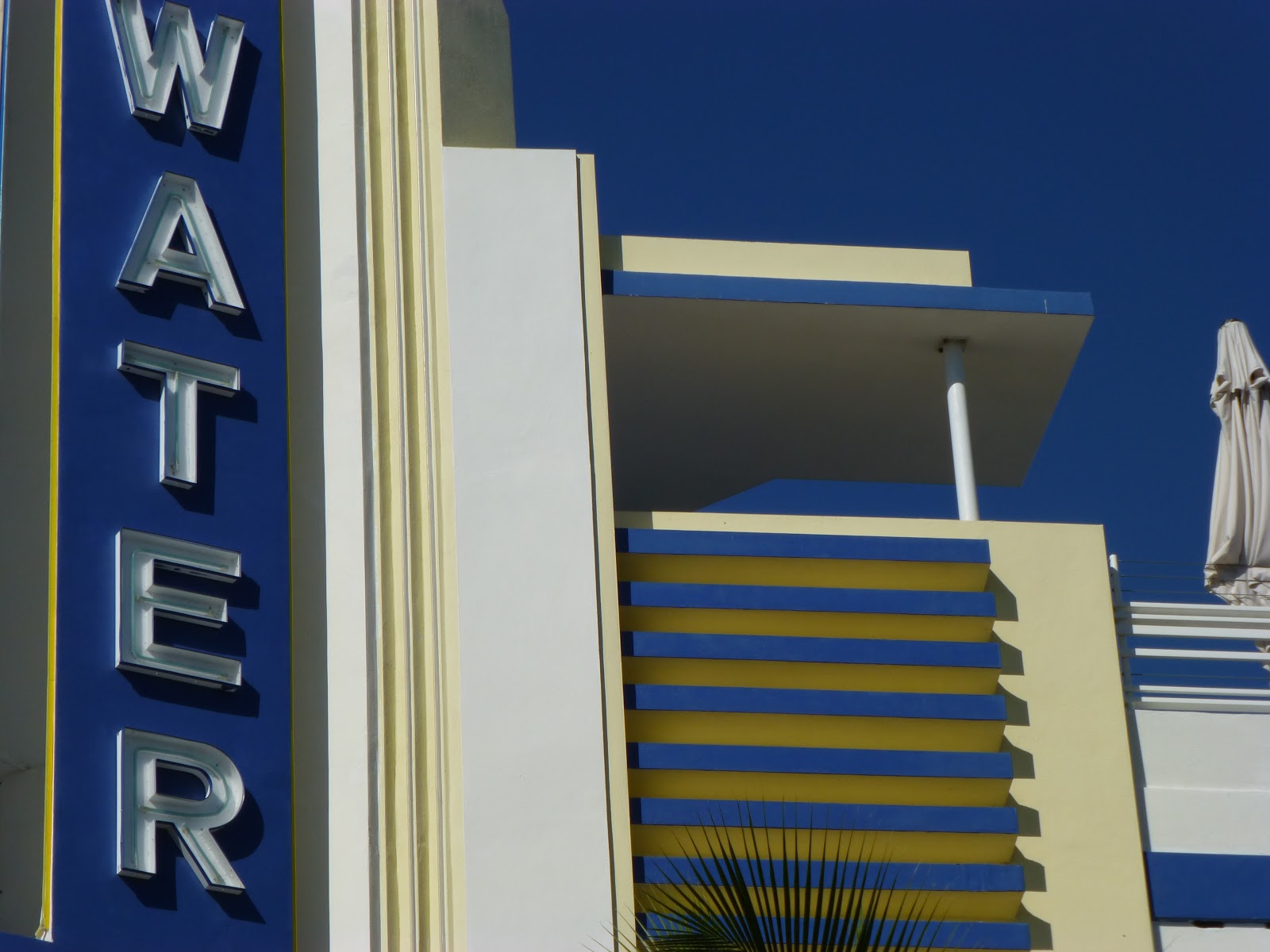
Miami Deco

One of the most fun aspects of touring Miami Beach was taking advantage of their bike share program, called Deco Bike, and riding all around the south end of the island, now known as the Deco District.


This area is comprised of lots of small hotels and apartment buildings, mostly built in the 1930's in the moderne or art deco style that was a popular offshoot of Bauhaus design.  In fact, the area this most reminded me of was the district of Tel Aviv that is known as the White City, built by many of the original Bauhaus architects when they had to immigrate from Germany to Israel in the 20's.


The Miami hotels are more playful and colorful, displaying a wide range of pastel tones, and some great signage.  It's become a really vibrant neighborhood, as can be seen in the movies The Birdcage, and, with a lot more violence and blood, Scarface.

I spent a couple of hours riding around and taking photos, and here are some interesting details I saw.


A Tale of Two Symphonies


We have just returned from a trip to Miami Beach, where I was fortunate enough to be able to go on a tour of the New World Symphony Center, designed by Frank Gehry.  Earlier this year, we attended a performance at Gehry's Disney Concert Hall in Los Angeles.  I thought it would be fun to post some photos and comments on the two buildings.


The New World Symphony Center was created by Ted and Lin Arison in 1987.  They were the owners of the Carnival Cruise Line, and wanted to create a venue for the advanced training of young classical musicians.  They brought in San Francisco Symphony Conductor Michael Tilson Thomas, and created a fantastic program, that is fully subsidized so that the students can participate as fellows for three years at no cost.  Each student works with a tutor, and also participates in the orchestra, and many are involved in music programs in the public school system.


Maestro Thomas brought in his old friend Frank Gehry to be the architect for the new center.  From the outside, it is a mostly very sedate building, facing a 2.5 acre public park.  The front facade is a blank white wall on the right side, and this is used for projecting live screenings of many of the concerts being performed inside.  The lawn is lined with two large arches containing over 100 speakers, as well as a very bizarrely shaped projection room.

The rest of the front is a simple glass curtain wall, but the very sculptural entry canopy gives a clue as to what you see once you walk in the front door.  Then you are in a large open, skylit space, filled with white sculptural forms, which house the rehearsal rooms.


It's a very dynamic and exciting space, which also includes a bar, topped with a floating blue metal sculptural element.  To the right of the entry, behind the blank white wall, is the main performance hall. I wasn't able to photograph this space, because there was a rehearsal in progress when we visited, but it too is very dynamic and colorful.  The fabric on the seats looks like a Miami bathing suit.  The seats wrap around all four sides of the elaborate, hydraulically operated stage platforms, and it's very intimate.  The acoustics are by Mr. Toyota from Japan, and it sounded great, despite the fact that they were rehearsing a very atonal piece by John Cage.


The Member's Lounge is located on the roof, with a large glass walled room, and a deck with amazing views out over the art deco hotel district and on to the Atlantic beyond.  The space is used regularly for receptions and other gatherings.

The New World Center is located right off Lincoln and Collins, in the heart of Miami's South Beach district, and it is well worth visiting.  They have really informative tours all through the day.


Earlier this year, we attended a performance at the Disney Concert Hall in Los Angeles.  This is a much more formidable and dynamic building from the outside, and stakes out a real presence in the performing arts area of downtown LA.  The administrative wing is a simple rectangular block, which serves as an effective backdrop for the wildly swooping titanium forms that wrap around the concert hall within.  The beautiful image above was taken off the internet, but the other photos in this post are all mine.

I liked the story that one of the elements, made of highly polished metal, was reflecting so much light into the neighboring office towers, that they had to retrofit it with a fabric "bra" to mitigate the problem.


The concert hall itself is a beautiful space, all in natural wood finishes, again with seating on all 4 sides of the stage.  The performance we saw was actually an opera (or to be honest, a half an opera, we couldn't sit through the whole thing!), so there was a flat stage platform set in front of the stepped area that housed the symphony itself.  We sat in one of the side terraces, and I have to admit, it wasn't very comfortable, because there wasn't any room to stretch out our legs.


One of the nicest parts of the Disney Hall is their rooftop garden, which unlike the members only deck at the Miami facility, is open to the general public, either during the day via a public stairway, or during intermission from the concert, when it can be accessed from the main lobby.  At night, this space was really magical, with beautifully lit trees, and this great mosaic fountain that looks like a giant blue flower.  Again, this space had great views out to downtown Los Angeles, but it was great even without those.


Both of these are exciting venues, providing flexible, acoustically wonderful performance halls, and dramatic lobbies and rooftop gardens.  I think these are two of Frank Gehry's strongest projects, because in both cases, the free form elements are played off against more rectilinear blocks, so there is a contrast.  Some of his other buildings, like the Experience Music Project in Seattle, are less successful to me, because they just have the curvy forms, with nothing to balance against.